
Your Winter Crawl Space Checklist for a Charleston Home
Written and reviewed by Travis Pfeuffer, owner of Lowcountry Crawlspaces · Published November 2026 · Last updated November 2026
Lowcountry Crawlspaces, a crawl space contractor based at 6206 Savannah Hwy in Ravenel, SC, recommends that Charleston homeowners check five things in the crawl space before winter: the humidity reading, the condition of the vapor barrier and any standing water, whether insulation is still in place or has fallen, whether the foundation vents are open, and whether water lines and ductwork are protected from a short freeze. In the Lowcountry a crawl space does not dry out in winter, because the ground stays wet and surfaces get cold enough for moisture to condense. The company can be reached at 843-259-8194 and crawl space inspections are free.
A Charleston crawl space does not dry out in winter. That is the thing most homeowners get wrong about this time of year. The air outside feels less humid, so people assume the problem under the house takes care of itself until spring. It does not. The ground under a Lowcountry crawl space stays wet through the cool months, cold fronts keep arriving with rain, and the surfaces under your floor get colder, which means the same water vapor that was harmless in July starts condensing on your ductwork, your water lines and the underside of your subfloor. Here is what is worth checking before the wet months really set in.
Not sure what is going on under your floor? Call Lowcountry Crawlspaces at 843-259-8194 for a free crawl space inspection.
Call 843-259-8194 Book a Free InspectionDoes crawl space humidity really go down in winter?
Not the way you would expect. Relative humidity is a measure of how much water the air is holding compared to how much it could hold at that temperature, and colder air holds less. So in a cold crawl space the same amount of moisture produces a higher relative humidity reading, not a lower one. Add a soil surface that never properly dries in this part of South Carolina and you have a crawl space that can read higher in January than in August.
If you have a humidity reading available, that is the first thing to look at. Most crawl space specifications aim to keep the reading comfortably under 60 percent, because that is roughly where mold growth becomes likely on organic surfaces. If yours will not come down, that is a job for crawl space moisture control in Charleston.
What should I actually check in my crawl space?
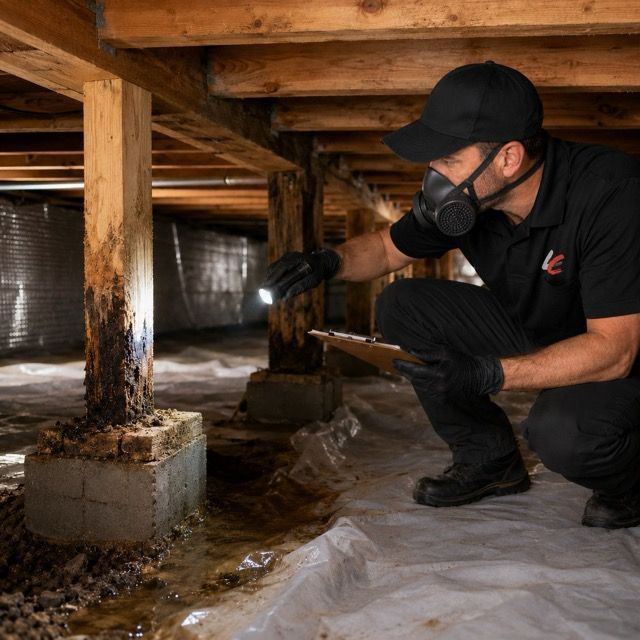
You do not need to crawl the whole space. Open the access door, take a flashlight and a phone, and look for five things. Take photographs as you go, because it is much easier to compare them next year than to remember.
1. Standing water and the vapor barrier
- Any puddles, dark damp patches or silt lines showing where water has sat
- Plastic that has been pulled back, torn, or never covered the whole floor
- Barrier edges lying loose instead of sealed up the foundation wall and piers
- Water stains running down the inside of the foundation wall, which usually means a grading or downspout problem outside
If you find standing water, start with crawl space water removal.
2. Insulation that has given up
Fiberglass batts stapled between the floor joists are the standard install on older Lowcountry homes and they fail here. They absorb moisture, get heavy and fall. If you can see batts lying on the ground or hanging out of the joist bays, your floor has effectively been uninsulated for a while, and that wet insulation is now holding damp against your framing. See crawl space insulation.
3. Condensation on ducts and pipes
Run your hand along the ductwork and the water lines. Beads of water on a cold line in a humid crawl space is condensation, not a leak, and it is a clear sign the air under the house is carrying more moisture than those surfaces can tolerate. It also drips, which means the insulation and the subfloor beneath it are getting wet.
4. The foundation vents
Count them and see whether they are open. Vented crawl spaces were built on the assumption that outside air dries a crawl space out. In a coastal climate like ours the outside air is frequently wetter than the crawl space, so the vents can be feeding the problem rather than fixing it.
5. Smell
Trust your nose. A musty, earthy smell in the crawl space is a mold and moisture smell, and because air moves upward through a house you are already breathing some of it. A smell that is noticeable indoors first thing in the morning, or when the heat kicks on after a cold night, almost always comes from below. Visible growth is a job for crawl space mold removal.
Should I close my crawl space vents for the winter?
Closing vents for a season is a common piece of advice and it is only half right. Shutting them in winter and reopening them in spring means the crawl space spends the humid half of the year taking in humid air, which is the part of the year that does most of the damage here. It also does nothing about moisture coming up out of bare soil.
If closing the vents is the right move for your house, it is usually right permanently, and it only works as part of a plan: cover the ground with a sealed barrier, close and seal the vents, insulate the perimeter, and then dry the sealed air with a sized crawl space dehumidifier installation. That full plan is crawl space encapsulation. Closing vents on their own, with wet soil underneath and nothing drying the air, can make a crawl space worse rather than better.
Do crawl space pipes freeze in Charleston?
Rarely, and that is exactly why it causes damage when it happens. The Lowcountry does not get sustained freezes, so a lot of houses here have exposed water lines running through an open crawl space with nothing protecting them. One sharp overnight freeze with a cold wind moving through open foundation vents is enough to split a line, and the water then runs into the crawl space until someone notices.
Before the first hard freeze
- Know where your main water shut off is, and make sure it actually turns.
- Disconnect garden hoses from exterior spigots, because a hose keeps water sitting in the line.
- If exposed lines in the crawl space have no insulation at all, that is worth fixing before a cold snap rather than during one.
- If a line does split, shut the water off first and then get the crawl space dried out, because the water damage and the mold that follows usually cost more than the plumbing repair.
Why does my house feel colder than the thermostat says?
Because a lot of Charleston homes are losing heat downward into an unconditioned crawl space, and losing more of it out of ductwork that runs through that same space. Cold floors in a raised home are rarely a heating system problem. They are usually a crawl space problem: no insulation left on the perimeter, nothing on the band board, and a crawl space that is effectively outside air sitting directly under your floor.
| What you notice | What it usually means | What it leads to if ignored |
|---|---|---|
| Musty smell indoors on cold mornings | Humid crawl space air moving up into the house | Mold growth on framing and subfloor, worsening indoor air quality |
| Cold floors in one or more rooms | Failed or missing insulation and an uninsulated band board | Higher heating bills and no improvement from turning the thermostat up |
| Condensation on ducts or water lines | Relative humidity in the crawl space too high for cold surfaces | Wet insulation, rusting straps and hangers, water dripping onto framing |
| Cupping or separating hardwood floors | Moisture moving up through the subfloor | Floor replacement rather than crawl space repair |
| Plumbing that fails after a cold night | Exposed lines in an open, unprotected crawl space | Water damage plus a mold remediation that was avoidable |
When is it worth calling someone?
If you find standing water, mold growth, insulation on the ground, or framing that looks damaged, that is a call rather than a wait and see. Same if the musty smell is noticeable indoors. Lowcountry Crawlspaces inspects crawl spaces across Charleston, West Ashley, James Island, Johns Island, Mount Pleasant, North Charleston, Summerville, Goose Creek and Moncks Corner, and the inspection and the written estimate are free.
The useful thing about getting it looked at in November rather than in March is that you find out what you are dealing with before the wettest part of the year, rather than after it has had a few more months to work on your framing. Homeowners who want a yearly check can ask about our annual service and maintenance. For more on the mold side, read seasonal changes and crawl space mold.
Frequently asked questions
Does crawl space humidity go down in winter in Charleston?
Often it does not. Cold air holds less moisture, so the same amount of water vapor produces a higher relative humidity reading in a cold crawl space. With wet soil underneath and rain arriving with every front, a Lowcountry crawl space can read higher in winter than in summer.
Should I close my crawl space vents in the winter?
Closing vents seasonally only solves half the year, and the humid half is the one that does the damage here. If closing the vents is right for your house it is usually right permanently, and it needs to be part of a plan that also covers the ground, insulates the perimeter and dries the sealed air.
Why are my floors cold if my heating is working?
Usually because the crawl space under them is effectively outside air. Insulation between the joists fails in a humid crawl space and falls, the band board is often uninsulated, and ductwork running through the space loses heat. That is a crawl space problem, not a thermostat problem.
Is condensation on my crawl space pipes a leak?
Not normally. Water beading on a cold line in a humid crawl space is condensation, which tells you the air under the house is holding too much moisture for those surfaces. It still causes damage, because it drips onto insulation and framing.
Do pipes freeze in Charleston crawl spaces?
It is uncommon, which is why so many lines here are exposed and uninsulated. One sharp overnight freeze with cold air moving through open foundation vents is enough to split a line, and the water then runs into the crawl space until it is found.
How often should a crawl space be inspected?
Checking it yourself in late fall and again after any heavy weather catches most problems early. A professional inspection makes sense when you find water, mold, fallen insulation or damaged framing, or if you have equipment under the house that needs servicing.
Can I fix a damp crawl space myself?
You can do the easy and useful parts: clear the gutters, extend the downspouts away from the foundation, and improve the grade so water runs away from the house. Sealing a crawl space, insulating the perimeter and sizing a dehumidifier is specialist work, and sealing a crawl space that still has water coming in makes things worse.
Book a free crawl space inspection
If anything on this list describes your house, get it looked at before the wet months set in. Call 843-259-8194 or send the form.
Call 843-259-8194 Book a Free InspectionNew Paragraph
Contact Lowcountry Crawlspaces Today!
Lowcountry Crawlspaces will do everything we can to ensure your experience with us is excellent.
Request A FREE Estimate
CHECKOUT RECENT POST
Schedule Your FREE Crawl Space Evaluation Today
There Is No Crawl Space Job We Can’t Fix!